Browsing the Internet, you’ve likely stumbled across one of those viral photo comparisons: on one side, an aged snapshot of chic Middle Eastern women from the early or mid-20th century in skirts or jeans and coiffed hair, evoking a cosmopolitan flair. On the other, a modern-day image of women draped in black niqabs, eyes framed by narrow slits of fabric. The captions usually drip with a patronizing nostalgia for a “lost” era of freedom and modernity, stolen by the rise of Islamist regimes. This reductive framing implies that women’s liberation is a Western concept, one that withered once the influences of colonialism retreated.
Or, you may have reacted quizzically upon learning that Iran is among the few nations that subsidizes gender reassignment surgery for transgender women, despite criminalizing homosexuality with the threat of death. Notably, transgender men are typically unmentioned— a detail that, tellingly, most people miss.
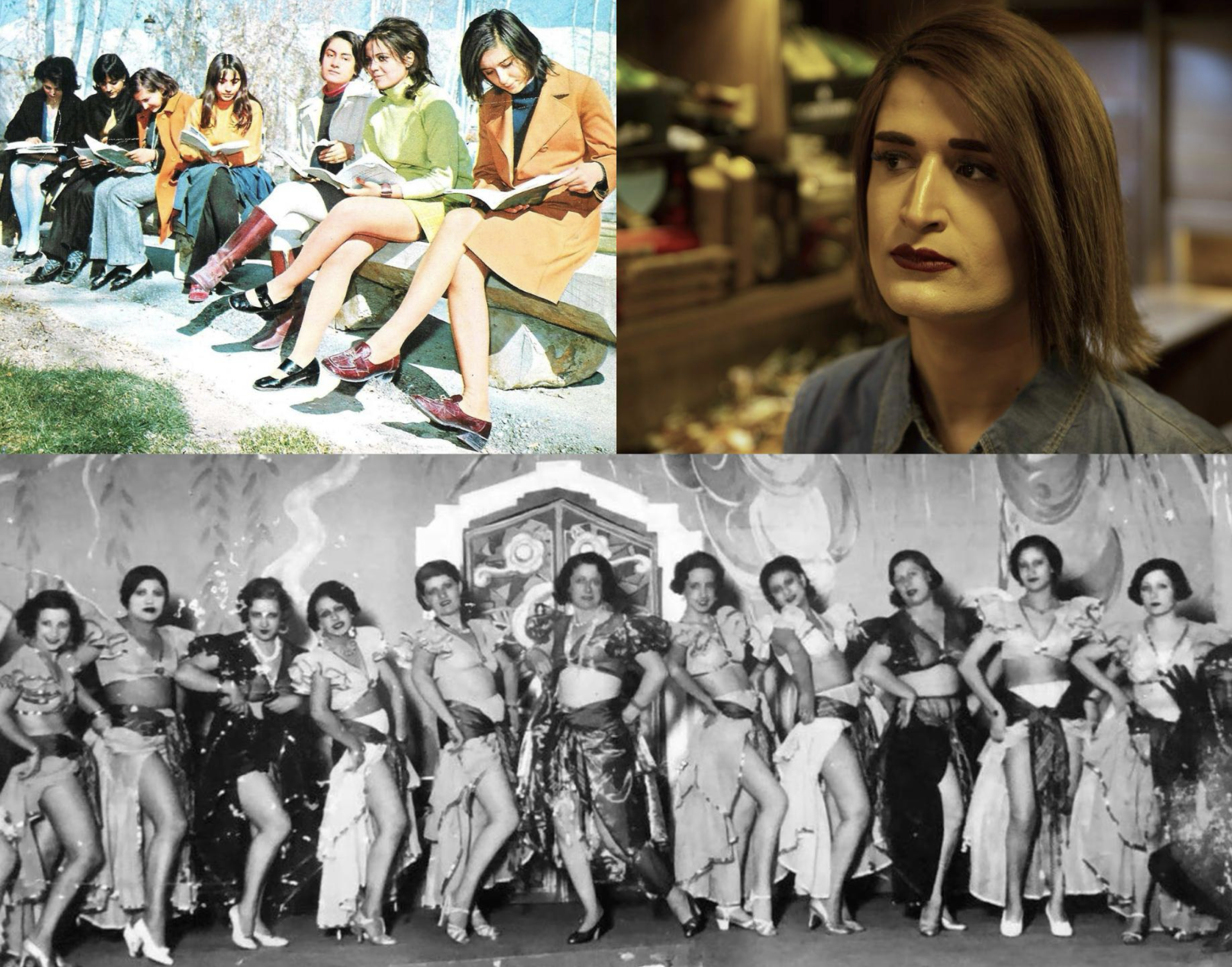
These evocative snapshots reveal a deeper truth: gender and sexuality have long been battlegrounds for statecraft and power. Yet, the obsession with these sensational stories, framed as something distinctively Middle Eastern, reveals more about us than it does about the region. Edward Said called this dynamic Orientalism: the Western tendency to flatten and caricature the East, casting it as inherently exotic and inferior. This is particularly true in the realm of gender and sexuality, where women and non-cisheternormative sexualities were evidenced as proof of cultural decadence and moral inferiority. For decades, women have been portrayed as oppressed victims in need of Western liberation, while men are depicted as hypersexual tyrants, or emasculated. These tropes persist today, shaping global perceptions and international policies.
However, the relationship between gender, sexuality, and state power in the Middle East is far more interesting than the reductive binaries presented in Western narratives. An exploration of these themes across four historical periods in both Egypt and Iran reveals a far more complex story of ongoing struggles for, and negotiations of, identity, power, and agency. The era of colonial and early modernization (19th century – 1940s) witnessed the emergence of colonial discourses that framed gender and sexuality as markers of difference between the “civilized” West and the “backward” East. During the period of nationalist and secular modernization (1940s – 1970s), newly independent states sought to reconfigure gender roles to promote national development, co-opting feminist movements and marginalizing LGBTQ+ identities. The Islamic revival and revolutions of the 1970s and 1980s reasserted “traditional” gender norms and a tightening of LGBTQ+ restrictions. Finally, contemporary struggles (1990s – present) of feminist and LGBTQ+ movements navigate the challenges of patriarchal authoritarianism and digital surveillance in their ongoing fight for equality and social justice.
The Colonial Era and Early Modernization (19th century-1940s)
Huda Sha’arawi’s unveiling, Lord Cromer, and Two Feminist Visions
In 1923, on the platform of a Cairo train station, Egyptian activist Huda Sha’arawi stood before a crowd and cast off her veil in a symbolic act of women’s emancipation. This moment electrified her supporters and inflamed her critics. While a Western feminist lens might reflexively lionize Sha’arawi, a deeper investigation reveals important cultural tensions at play. Sha’arawi’s feminism appealed to Egypt’s elite, women whose access to education and international travel aligned them more closely with Western notions of progress than with the lived realities of rural and working-class women.
Sha’arawi’s unveiling transpired at the turbulent intersection of colonialism, nationalism, and gender politics. At the time, Egypt was grappling with the dual pressures of British occupation and a burgeoning nationalist movement that sought to define modernity on its own terms.
For colonial administrators like Lord Cromer, the veil was a convenient symbol of Egypt’s supposed backwardness—a justification for British domination. Cromer famously claimed that “the position of women in Egypt” was “a fatal obstacle” to progress. Yet Cromer’s ostensible concern for women’s liberation was hypocritical: back home, he actively opposed suffrage for British women.
Meanwhile, Egyptian writer and intellectual Malak Hifni Nasif shared Sha’arawi’s commitment to women’s rights but diverged in her approach. Nasif advocated for a feminism rooted in Arabo-Islamic culture, emphasizing the need for reforms rooted in Egypt’s sociocultural realities. Veiling represented a multiplicity of meanings for many women: an act of piety, a reflection of cultural values, or a pragmatic measure for safety. Rejecting mandatory unveiling, Nasif advocated for women’s right to choose for themselves.
Reza Shah’s Unveiling Act, and Class Divisions surrounding the Veil
Iran’s encounter with modernization vis-à-vis the veil unfolded under state coercion. In 1936, Reza Shah Pahlavi, then royal dictator of Iran, enacted the Unveiling Act, requiring women to appear in public without veils. Enforcement was cruel: police tore veils from women’s heads in the streets and barred them from schools, clinics, and public transport if they refused to comply.
Elite women, aligned with Reza Shah’s modernization agenda, embraced unveiling as a symbol of progress, celebrating the integration of women into public life. They believed that working-class and rural women would eventually welcome the change. Yet for many women, especially lower-class women, unveiling was a profound violation that severed the protective boundary between andaroon (the private, domestic sphere) and birooni (the public sphere). For them, unveiling was akin to being naked in public and exposed them to bisharmi— a state without shame or charm.
The Unveiling Act laid bare the chasm between Iran’s urban elite and its working class. It alienated large swaths of the population, exposing the deep disconnect between the state’s vision of modernization and the lived realities of its people. What the state and elites heralded as liberation was experienced by many as coercion, deepening the resentment that would fester in the decades to come.
The experiences of Egypt and Iran during this period reveal how gender, particularly through the politics of veiling, became an arena where competing forces—European colonialism, nationalist resistance, class hierarchies, and cultural authenticity—sought to define modernity and identity on their own terms. European colonialists, wielding an Orientalist gaze, cast veiled women as symbols of backwardness, using this framing to justify their domination and exploitative motives. In turn, nationalist resistance, especially via elite ambitions, sought to advance their own projects of sovereignty and modernization, appropriating veiling as part of their goals. Amid these competing forces, working-class communities were forced to navigate these larger social, economic, and political dynamics. For working-class women in particular, veiling became both a site of control and a tool of resilience, as they leveraged it to assert their dignity, ensure personal safety, and maintain cultural belonging. As competing forces battled to define the Middle East in the age of colonialism and modernization, women’s bodies were marshalled to the frontlines, bearing the brunt of histories of struggle and violence.
Nationalist and Secular Modernization (1940s-1970s)
By the mid-20th century, colonial powers had largely retreated from the Middle East, leaving behind fractured states grappling with the question of modernity. In both Egypt and Iran, this period was defined by aggressive state-led projects of secular modernization, which positioned women at the heart of national development. From Cairo to Tehran, women’s roles in society and their bodies were to be instrumentalized for state-building modernization projects.
Nasser, Pan-Arab Nationalism, and Women in the Nation
In 1952, the Free Officers Movement, led by Gamal Abdel Nasser, overthrew Egypt’s British-aligned monarchy in what became known as the Free Officers Coup. A charismatic and ambitious leader, Nasser consolidated power within his hands and heralded a new, often hopeful, era for Egypt and the Arab world. His vision of Pan-Arab Nationalism and Arab Socialism positioned Egypt as the vanguard of the Arab world, championing Arab pride and self-determination, and challenging both Western imperialism and domestic class inequalities.
For Western powers, particularly the United States and Britain, Nasser represented a destabilizing threat in the theater of Cold War geopolitics. His bold nationalization of the Suez Canal in 1956, then beholden to British and French interests, solidified his image as a hero of anti-imperialism and Arab sovereignty.
Women played a crucial role in the regime’s modernization project. Women’s participation was both symbolic and practical, projecting an image of progress and egalitarianism while benefiting from women’s participation in the workplace and family life. The state framed women’s education and employment as critical to achieving economic self-sufficiency and national development. Socialism and social freedom could be realized only “through an equal opportunity for every citizen to obtain a fair share of the national wealth,” both men and women. Politically, women gained the right to vote and hold office in 1956, further polishing Nasser’s image, especially on the international stage.
After the Egyptian revolution, veiling virtually disappeared from the Egyptian urban scene as women settled into Nasser’s modernist state. Notably, women of the upper and middle classes of major cities had already abandoned the veil, while working-class women of small towns and rural areas continued to veil, once again evidencing how the politics of veiling intersect with class dynamics.
While Nasser’s policies expanded opportunities for women in education, employment, and politics, they were not necessarily universally liberating. The authoritarian regime placed patriarchal expectations on women as mothers and moral guardians, and sidelined organic feminist movements, such as the Egyptian Feminist Union, by redirecting their energies to state-defined goals. In 1961, the Law on Combating Prostitution passed. Intending to root out the immoral vestiges of colonial-era brothels, the law disproportionately targeted working-class women through moral policing. Yet again, Arab women’s bodies became sites for moral authority and control.
Mohammad Reza Shah, the White Revolution , and Veiling as Resistance
Mohammad Reza Shah Pahlavi ascended the throne in 1941, after U.S. and British forces pressured his father, Reza Shah, to abdicate. At just twenty-one years old, Mohammad Reza inherited a monarchy that was weakened by economic instability, political fragmentation, public discontent, and Allied occupation. The inexperienced Shah thus began his rule cautiously and less authoritarian than his father, and often relied on Western powers for support and guidance. The new Shah would seek to continue secular, Western-style modernization, but had to navigate the rocky terrain of an enfeebled Iran.
In a move to consolidate power, the new government rescinded the polarizing Unveiling Act. While veiling was now, ostensibly, a choice, its presence came with a social prejudice. While the veil persisted as an important cultural and religious practice among working-class women, veiling remained stigmatized within upper- and middle-class urban circles, where its absence was associated with modernity and progress.
In the late 1940s and early 1950s, the Shah’s authority was challenged by popular democratic forces and nationalist politicians. Prime Minister Mohammad Mossadegh rose to prominence for his personal integrity, staunch nationalism, democratic ideals that challenged monarchical power, and his opposition to foreign exploitation. In 1951, Mossadegh was the driving force behind the nationalization of Iran’s oil industry and became a national hero. Until then, it had been controlled by the British-owned Anglo-Iranian Oil Company (an antecedent of the contemporary BP). By 1953, Mossadegh’s government sidelined the Shah, forcing him to flee the country. Later that year, the CIA and British MI6 orchestrated Operation Ajax, a coup that deposed Mossadegh and reinstated Mohammad Reza Shah. The coup exposed the scope of American and British influence, furthering Iranian resentment of the Shah.
The 1953 coup marked a turning point for the Shah. He returned determined to consolidate his power and eliminate challenges to his rule. Bolstered by U.S. and British support, the Shah had thousands arrested, imprisoned, or executed. The Shah also established the notorious SAVAK, a brutal secret police force trained with American and Israeli assistance. Simultaneously, he received economic aid and military assistance from the United States to stabilize his regime and expand Iran’s military. Politically, he rigged elections and packed the Majlis with loyalists, obstructing democratic avenues and transforming the state into a de facto autocracy.
In 1963, the Shah launched his most ambitious plan yet, the White Revolution, a blueprint for transforming Iran into a modern, industrialized society under his centralized control. It deeply altered the fabric of society, from land ownership, to gender roles, education, and the economy. While they benefited urban and middle-class populations, they alienated traditional elites, rural communities, and religious leaders who viewed the changes as culturally disruptive and morally suspect.
The role of women in society, especially as visible symbols of modernity and progress, was crucial to the White Revolution. The Shah’s reforms included landmark achievements such as granting women’s suffrage in 1963, enabling them to vote and stand for election for the first time in Iran’s history. The Family Protection Law of 1967 introduced some of the most progressive policies in the region, such as limiting polygamy, improving divorce rights for women, and granting women a legal claim to child custody. Additionally, the Shah promoted state feminism through institutions like the Women’s Organization of Iran (WOI), led by his sister Ashraf Pahlavi.
While the White Revolution’s gender reforms appeared progressive from the outside, the Shah’s top-down state feminism was fundamentally flawed. Policies disproportionately benefited urban, middle and upper class women, largely overlooking rural and working-class women. The state-sponsored WOI replaced more grassroots, independent women’s organizations, enabling the state to dictate the terms of women’s activism. Crucially, these reforms failed to tackle the systemic roots of patriarchy, allowing men to maintain significant legal and social advantages despite the appearance of progress.
By the mid-1970s, the veil acquired a renewed symbolism: an opposition to the Shah’s regime. Islamist movements redefined veiling as a moral and political act, rejecting secularism. Among university students, the veil signified a critique of authoritarianism. Even secular leftists, who previously associated unveiling with progress, adopted veiling in solidarity with religious and working-class people. This conjoining of otherwise disparate ideologies under the banner of veiling demonstrated the Shah’s failure to unify the country and highlighted how gender was a battleground for Iran’s competing visions of identity and governance.
Nasser’s Egypt and Mohammed Reza Shah’s Iran underscore the complexities of using gender as a marker of national progress. While their modernization projects proclaimed a break with the past, their paternalistic approach often reinscribed patriarchal control over women’s bodies and role in society, and created divisions between women of different class strata. Through it all, women found resistance and pride in both veiling and unveiling, demonstrating their resilience and agency.
Islamic Revival and Revolution (1970s and 1980s)
The Contemporary Era (1990s - present)
Works Cited
Ahmed, Leila. Women and Gender in Islam: Historical Roots of a Modern Debate. Yale University Press, 1992. JSTOR, http://www.jstor.org/stable/j.ctt32bg61. Accessed 18 Dec. 2024.
Axworthy, Michael. “Reflections on the Origins of the Revolution of 1979 in Iran - Why History Matters.” Paper No. 99, Institute for Middle Eastern and Islamic Studies, Oct. 2019.
El Guindi, Fadwa. “Veiling Resistance.” Fashion Theory, vol. 3, no. 1, 1999, pp. 51–80. https://doi.org/10.2752/136270499779165626.
Massad, Joseph A. Desiring Arabs. University of Chicago Press, 2008.
Najmabadi, Afsaneh. Women with Mustaches and Men without Beards: Gender and Sexual Anxieties of Iranian Modernity. 1st ed., University of California Press, 2005. JSTOR, http://www.jstor.org/stable/10.1525/j.ctt1ppqcv. Accessed 18 Dec. 2024.
Naghibi, Nima. “Bad Feminist or Bad-Hejabi?: Moving Outside the Hejab Debate.” Interventions, vol. 1, no. 4, 1999, pp. 555–571. https://doi.org/10.1080/13698019900510821.
Tohidi, Nayereh. “Women’s Rights and Feminist Movements in Iran.” SUR 24 - v.13 n.24, 2016, pp. 75–89. SSRN, https://ssrn.com/abstract=3028205.
“Dreams & Genocide: Yemen.” YouTube, uploaded by The Austin School, 29 Oct. 2019, https://www.youtube.com/watch?v=CZcJyTWAT-c.