This textbook provides a broad survey of the major theoretical perspectives of learning and memory.
Ch. 1, History of Learning and Memory
Learning objectives:
- Identify the contributions of philosophers to the early study of learning and memory.
- Understand the basic assumptions of behaviorism.
- Summarize the major contemporary approaches to the study of learning and memory.
- Describe the six themes of the textbook.
Ultimately, who we are is what we learn and remember.
Understanding ideas from the (pre-scientific) past can help us understand modern research and theory.
Early Philosophical Approaches
Socrates suggested that objects in memory are based on the function they play. For example, we recognize a coffee mug even if it’s made of different materials or is damaged.
Aristotle claimed that there are different mechanisms for learning such as similarity, contiguity, and causal properties.
Descartes, a rationalist, believed some knowledge was innate such as perfection, time, hope, and infinity. He posited the mind-body distinction (dualism) and concluded the body interacted with an immaterial soul in the brain.
Locke, considered an empiricist, believed all human knowledge comes from experience and at birth we are devoid of ideas— a tabula rasa. His associationism was the foundation for 20th century behaviorism.
Kant’s interactionism bridges Locke and Descartes, emphasizing that while empirical experiences are indispensable, the mind’s inherent cognitive frameworks play a crucial role in shaping and interpreting these experiences. Kant used schema to describe the abstract knowledge that we mentally form of the external world.
William James (1842–1910) is considered the founder of American psychology and the transition point between philosophy and psychology. James believed the nervous system is modified by experience. We use memory to reproduce earlier events and facts, which leave traces between nerve centers and the brain. Experience adds to the traces of a memory and strengthens it.
Kant and James began the process of modernizing conceptualizations of learning and language around memory.
Twentieth-Century Behaviorism
Behaviorism began in the early 20th century and lasted well into the 1960s. It focused on observable behavior and considered unobservable phenomena unscientific. This meant topics such as consciousness, motivations, personality, thought, and memory were considered off limits. They used Locke’s idea of a blank slate and associations and reframed them as stimulus-response associations.
Contemporary Approaches
By the 1970s, a renewed interest on mental activities meant a shift in focus away from behaviorism.
Social learning
Social learning theory (aka social cognitive theory) describes how people learn when in relationship with others, including social comparison, sense of equity, and self-efficacy.
Cognitive psychology
Cognitive psychology is the study of higher mental activities, encompassing language, attention, knowledge acquisition and representation, and decision making.
Cognitive psychologists use and propose information-processing theories, and examine metacognition and metamemory.
Information-Processing Theories
A long-standing, fundamental assumption in cognitive psychology is that the human mind is like a computer and examining its capacity, speed, and abilities.
Hermann Ebbinghaus (1850–1989) was a pioneer, performing experiments and collecting data on learning and memory.
Modern researchers often rely on three key functions to describe human memory:
- Encoding: sensing stimuli and extracting meaning from it.
- Storing: retaining information for a period of time, seconds or decades.
- Retrieval: attempting to remember some information.
The Atkinson-Shiffrin model (aka multi-store model or modal model) was published in 1968. While still useful, modern memory research is more targeted. It’s a good example of an information-processing theory:
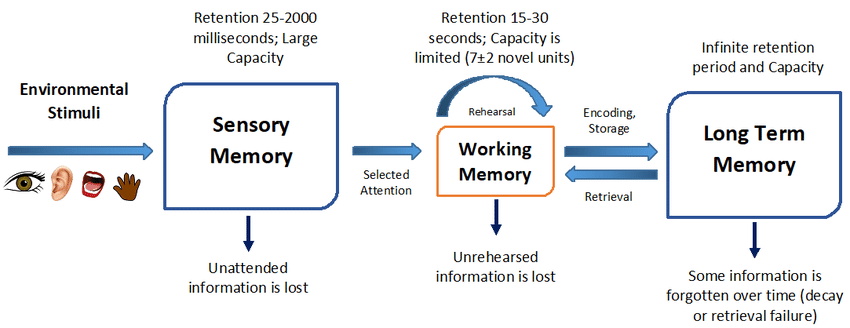
Of primary interest to cognitive psychologists is what information a person uses when he or she wrestles with an important decision. The mechanics of brain functioning are usually of secondary interest.
Metamemory Awareness and Strategies
Metamemory, coined in 1970, is part of metacognition and involves awareness of one’s own learning and memory strengths and strategies.
- For example, deciding whether you’re better at spelling or grammar, or to make flashcards for study, or assessing how much study time you need.
Cognitive Neuroscience
Neuroscientists examine the brain and nervous system, focusing on 1) neurons, 2) synapses (gaps between neurons), and 3) neurotransmitters.
- Neuroimaging allows visualization of brain activity.
- Single-cell recording activates and studies single neurons.
Integrating the Approaches
Social learning and cognitive psychology are mutually reinforcing due to similar behavioral assessments and researcher training.
However, integrating neuroscience and cognitive psychology has been challenging. Neuroscience studied the body (mind) and cog psych studied the mind, leading to a difference in education and training.
- Neuroscientists study the brain from a metabolic “systems” perspective.
- Cognitive psychologists use a “process” approaching, focusing on how the mind functions without necessarily linking to specific brain structures.
- The Atkinson-Shiffrin model describes memory processes sequentially, but the brain functions dynamically and interconnectedly.
Perhaps cognitive psychologists are best at identifying what the mind does, and neuroscientists uncover how the brain enables it.
The four primary approaches to learning, with a biological basis underneath:
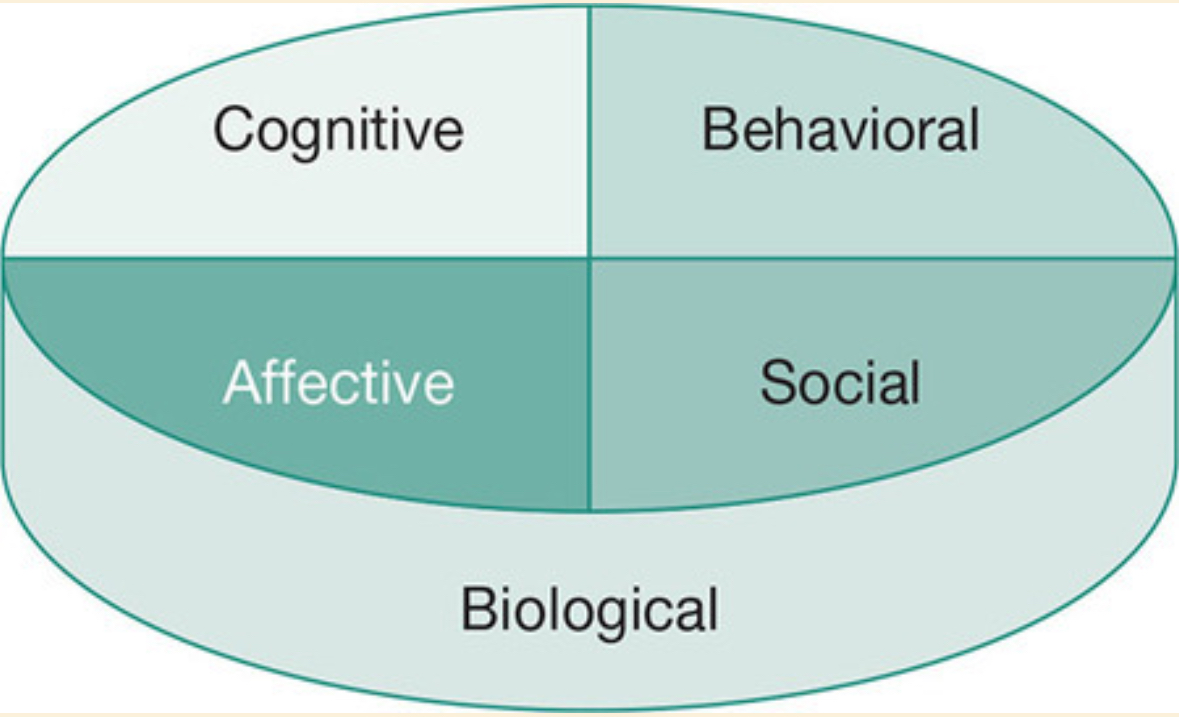
Behavioral approaches to learning focus solely on the actual movements of a learner. Social learning takes into account the presence of others and to whom we give the credit for our learning (ourselves or the situation). Cognitive theories of learning focus entirely on the mental processing that occurs to encode, retain, and retrieve information. Emotions and our motivations play a clear role in learning as well. Underlying each of these approaches, of course, are the biological structures that support the organism’s capabilities.
Recurring themes in the book
- There are different kinds of learning (cognitive, behavioral, social), and our emotions and motivations play a role in what we learn and store.
- We are constantly learning at multiple levels of (un)awareness.
- The brain is the basis of several separate memory systems.
- Complex memories are stored across the brain.
- The human memory system’s best trait— learning the gist of something— can be its biggest weakness.
- Learning context helps us remember, but can limit our ability to recognize when our knowledge will be useful.
Chapter 1 Summary
Philosophers posited a number of ideas that are still with us today. One is the distinction between memories of sensory experiences and abstract ideas. Some philosophers proposed that the purpose or meaning of a particular object, its function, is what defines an object, more than its actual structure. Ideas may be formed through the association or connection of several events or ideas to each other. Descartes was responsible for making the distinction between the mind and the body, a distinction between mental function and physical structure; but it was Kant who reconnected them by explaining how the physical form gives rise to the capabilities for mental abilities and understanding. Locke believed that all knowledge was a combination of sensory experiences in some form; but Kant asserted that we construct our understanding of the world instead, which means it is an interpretation and can be inaccurate. William James defined memory as knowledge of an event that we currently do not have in conscious awareness, and he used the term “traces” to describe the paths of memories across centers of the brain.
The approaches that will be the focus of this book are: behavioral theories of learning (Chapter 4), social learning theories that examine the role of others (Chapter 5), cognitive learning theories that take either an information-processing approach or metamemory approach (Chapter 7), emotional and motivational influences on learning and memory (Chapter 6), and cognitive neuroscience attempts to account for the biological underpinnings of human learning and memory (Chapter 3).
Ch. 2, Common Research Methods in Learning and Memory
Learning objectives:
- Identify the common features of learning and memory studies (e.g., performance tasks and performance measurements).
- Define and distinguish between the three common approaches to the empirical study of learning and memory.
- Describe the characteristics that can be used to evaluate the quality of a study.
Chapter 2 Summary
- Virtually all studies feature some task that the participants do or are observed doing.
- It typically involves learning and then retrieval. For example, studying lists of words, paired-associate tasks, dual tasks, or implicit learning tasks that the participants aren’t aware of.
- Typical measurements of performance include accuracy (usually % correct / incorrect), efficiency in processing (reaction time), judgments about their own accuracy, and brain imaging.
- Common research designs involve surveys and interviews, memory diaries, and experiments.
- Surveys can be built relatively quickly and are an inexpensive way to collect data, but the data collected isn’t the most reliable or accurate.
- Memory diaries are intensive, longitudinal records of personal events that researches can quiz themselves over later on. While powerful, they take a long time and are vulnerable to personal bias.
- Experiments can make casual connections between variables.
- Experiments are the most powerful technique for understanding human psychology; but they require careful planning to execute well and may not resemble real life if too highly controlled (lacking ecological validity.)
- All studies can be evaluated for their internal validity (how well the study was constructed an can be replicated) and external validity (to what extent the results can be generalized.)
Ch. 3, Neurological Basis of Learning
Learning objectives:
- Describe how neurons communicate information.
- Explain how learning may occur at the cellular level.
- Describe how classical conditioning theory explains basic associative learning.
- Define skill learning, and identify the optimal forms of practice and feedback for learning.
- Define implicit learning, and describe what is learned in implicit learning.
Chapter 3 Summary
- Neurons communicate (neurotransmission) by releasing chemicals (neurotransmitters) between them.
- Neurons support learning one one of three ways:
- changes in the amount of neurotransmitters released
- modifying existing dendrites
- new neuron growth
- Neurons support learning one one of three ways:
- The sea slug, Aplysia, demonstrates basic aspects of nonassociative learning, or learning where only one stimulus is involved.
- Habituation: Decreased response to repeated stimulus.
- Spontaneous recovery: Full-strength response after stimulus break.
- Classical conditioning is learning to associate environmental cues with upcoming events.
- Skill learning involves executing a series of actions on demand.
- Expertise requires years of practice aimed at eliminating mistakes.
- Interrelated (as opposed to singular) skill practice produces better long-term performance.
- Feedback is crucial to the learning process.
- Guidance is helpful initially, but it needs to be tapered off.
- Cumulative feedback often works better than feedback on each performance.
- Implicit learning is learning without conscious awareness.
- What we learn implicitly seems to be relatively shallow and is hard to verbalize or reorganize.
Ch. 4, Behavioral Learning
Learning objectives:
- Explain the basic assumptions of operant conditioning theory.
- Describe the role of reinforcement for changing the rate of behavior.
- Identify the impact on behavior change that different schedules of reinforcement have.
- Classify different forms of reinforcement as demonstrations of shaping, chaining, and stimulus control.
- Explain the principle of biological constraints on reinforcement.
- Describe avoidance conditioning as an alternate form of reinforcement.
- Explain how operant conditioning theory explains punishment and why the theory sees limited value in punishment.
The major theory presented in this chapter is operant conditioning, combined with Pavlov’s classical conditioning theory, comprising behaviorism.
Operant conditioning versus classical conditioning:
- Operant conditioning involves voluntary behaviors— gain reward or avoid punishment. e.g. Dog sits for treat.
- Classical conditioning involves involuntary responses— automatic reactions elicited by conditioned stimuli. e.g. Dog salivates to bell.
Operant Conditioning Theory
Operant conditioning is a fundamental theory in behavioral psychology developed by B.F. Skinner.
In operant conditioning, a cue triggers a behavior response, which is followed by a consequence, influencing the likelihood of a behavior reoccurring.
The individual “operates” on the environment, hence the name.
Exclusive behavioral explanations for learning, avoiding claims of motivation, personality, or knowledge, was embraced by early 20th century psychology as more scientific.
When the environment produces something as a result of an action it is termed positive. When the environment removes something, it is termed negative. The terms are purely mathematical, not indicating desirability.
| Strengthened behavior | Weakened behavior | |
|---|---|---|
| Stimulus presented | Positive reinforcement | Positive punishment |
| Stimulus removed | Negative reinforcement | Negative punishment |
Schedules of Reinforcement
Continuous reinforcement: When the reinforcing consequence is produced with every appropriate behavior. This provides fastest learning but isn’t always feasible.
Noncontinuous (intermittent) reinforcement: Reinforcing consequence is produced only sometimes. Associated with longer lasting learning.
The four basic schedules vary on two dimensions: whether the reinforcement is provided over a fixed or variable number of correct behaviors (ratio schedules) and whether the reinforcement is provided over a fixed or variable period of time (interval schedules).
- Fixed Ratio schedule: A worker receives payment for every X units produced.
- Variable Ratio schedule: Gambling on a slot machine.
- Fixed Interval schedule: A weekly paycheck.
- Variable Interval schedule: Pop quizzes once a week, on any day.
Chapter 4 Summary
- Operant conditioning theory explains learning via behavioral observations, focusing on reinforcements (rewards) and punishments.
- Reinforcement (reward): Increases likelihood of behavior reoccurrence.
- Punishment: Decreases likelihood of behavior reoccurrence.
- Positive reinforcement / punishment: A stimulus presented.
- Negative reinforcement / punishment: A stimulus removed.
- Reinforcement schedules
- Noncontinuous (intermittent) reinforcement makes behaviors resistant to extinction, but learning may take longer compared to continuous (consistent) reinforcement.
- Ratio schedules: Reinforcement after a fixed or average number of responses.
- Interval schedules: Reinforcement after a fixed or average length of time.
- Avoidance conditioning: Behavior to avoid unpleasant consequence; reinforced by successful avoidance.
- Punishment can be effective but has drawbacks.
- Effective when strong, immediate, consistent, and coupled with reinforcement of optimal behavior.
- Drawbacks: habituation, anger & negative emotions, dislike of punisher, and avoidance conditioning (avoiding punishment rather than changing behavior.)
- Operant conditioning is older, remaining foundational and expanded upon.
- Newer theories incorporate social context, motivation, goals, and mental representations of knowledge.